
Student Spotlight: Anushka Dar
Meet Anushka Dar
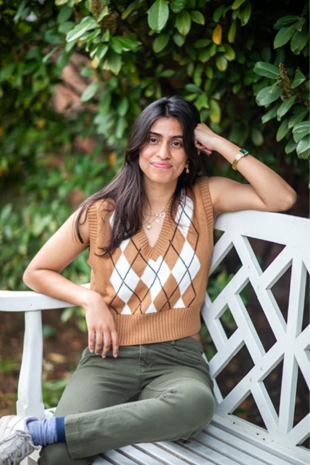
Anushka Dar (she/her) is a first-year MHS student in the Health, Behavior and Society degree program.
- Program: MHS in Health, Behavior, and Society
- Entry year: 2025
- Hometown: Bethesda, MD
- Fun fact: I used to be in a South Asian fusion a cappella group! Check out Ektaal A Cappella on Spotify and YouTube and Instagram (I was also their publicity chair).
What sparked your interest in public health?
When I first began my undergraduate education, I was convinced that I was going to study molecular biology, because my high school biology teacher focused on the ethical, legal, and social implications of the field, and I found myself enamored by this aspect of scientific study and research. How could we best challenge the ethical challenges that may come with scientific progress? How do we make it so that the sustainable well-being of individuals is prioritized over what may seem to be a magic cure to genetic disease? These were the questions that propelled me. Upon working at a lab, however, I realized that this was not the work that I wanted to be doing. I enjoyed bench work, but I found myself lacking the human connection and component to the work that was the main driver behind why I wanted to pursue molecular biology in the first place.
I then realized that public health was the field that contained all the components I was seeking: community-based, connection-driven work that can be used to mitigate social, political, and economic drivers of health to create justice-oriented health outcomes for everyone. As a queer woman of color, I have seen and experienced the ways in which systemic infrastructure does not serve—and oftentimes works against—the basic needs of communities that I am a part of. This lack of systemic care has significant impacts on our health and well-being. In my desire to challenge oppressive systems, I found public health to be an essential tool for progress.
I was then brought on to a research project that solidified my interest in the field. This project enabled me to talk to community health workers in the largest labor union in India and to advocates for change in South Africa through the Movement for Change and Social Justice. Doing so reaffirmed my belief that community care is everything—the shared commitment that individuals in these organizations had to one another and to achieving greater health justice and equity acted as a model I believe our systems should be foundationally based on and affirmed that community-driven health work is what I hope to spend my life pursuing.
What led you to join the Department of Health, Behavior and Society?
I was drawn to HBS given the ways in which I have experienced and seen how oppressive social systems are some of the most fundamental causes of health inequity and injustice. The values of the department, such as anti-oppressive social justice and relationship centeredness stood out to me, and I felt as though HBS was the only program that truly highlighted the importance of reckoning with and challenging social systems in communities. As someone who hopes to do community-based work and co-create tangible, material impacts that subverts oppressive systems, HBS seemed like the perfect fit for me.
What’s an academic highlight you've experienced during your time as an HBS student?
I truly believe that the HBS 2025–26 is the best cohort at the Bloomberg School. My classmates are all incredibly intelligent, fun, hardworking, and caring, and I feel as though I belong in this environment. I enjoy spending my days in the classroom with my peers and supporting one another in getting our work done.
I find myself inspired by many of my professors. Despite having only taken one term of classes so far, it is clear to me that the faculty and staff within HBS are highly dedicated to their research and to developing solutions that improve health outcomes for all people. They also care deeply about students and are willing to make time for conversation despite their busy schedules.
What’s a research highlight you have experienced during your time as an HBS student?
While I have just begun my journey as an HBS student, I am looking forward to seeing what research opportunities lie ahead of me. There are so many opportunities for community-based and engaged research at the Bloomberg School. I have been enjoying looking through these potential opportunities and beginning to envision what my summer research placement may look like.
I am particularly interested in health justice research focused on community-based and grassroots health systems interventions, particularly in relation to communities of care. I am drawn to doing research with communities to highlight the protective and lifesaving impacts of social networks and mutual aid—particularly in communities that are multiply marginalized—that allow for flourishing despite oppressive systems. I hope to engage with co-creating worlds that prioritize resource-sharing, power redistribution, and kinship.
Outside of public health, what are some of your hobbies, interests, and passions?
I love to explore wherever I’m living! You’ll always find me trying to convince my friends and family to go to a café, bookstore, pop-up, festival, show, or vintage market in Baltimore. There are so many fun things to do here all the time. I also love listening to music, reading, and singing. I’m also trying to become the type of person who can make delicious, caffeinated beverages at home… although I can never resist getting boba.
What are some of your favorite places in Baltimore?
I love Baltimore! Growing up in Maryland, I had the opportunity to visit Baltimore as a kid and do all of the touristy things (go to the aquarium, watch a baseball game, visit the Inner Harbor), and I’ve loved getting to learn more about Baltimore’s different neighborhoods by living here. I’m a big café person, so some of my favorite cafés have been Red Emma’s (their events are amazing), Good Neighbor, and Café Dear Leon (the crab dip bagel is no joke). I also highly recommend taking advantage of the Baltimore Museum scene. The BMA and the Walters are amazing (and free!) and the American Visionary Art Museum has one of the coolest toy and action figure displays that I’ve ever seen.
What advice do you have for prospective students interested in joining the HBS community?
I highly recommend being engaged with the Baltimore community, whether that be in your neighborhood or on a larger scale, and taking time to reckon with the harmful history and present of institutions in Baltimore and how to uplift and fight for the voices of those who have been unheard.
I am constantly motivated by Mariame Kaba’s quote: “Hope is a discipline and we have to practice it every day.” While the uncertain present and future of public health can oftentimes feel demotivating, it is essential to retain hope in our vision for a better world. In doing so, we have the responsibility to remain engaged with the world around us.
This interview has been edited for length and clarity. Views expressed are the subject's own.