

The Public Health Approach to Prevent Gun Violence
This approach brings together a range of experts across sectors—including researchers, advocates, legislators, community-based organizations, and others—in a common effort to develop, evaluate, and implement equitable, evidence-based solutions.
A public health approach can prevent gun violence and advance health equity so everyone can live safely.
Gun violence is a public health epidemic.
In 2023, 46,728 people died by guns, marking the third-highest number of gun-related deaths ever recorded in the United States.1
The public health approach
The public health approach to prevent gun violence addresses the many forms of gun violence by focusing both on firearm access and underlying risk factors that contribute to gun violence.
It's Comprehensive
This comprehensive approach to tackling public health crises in America has been used over the last century to eradicate diseases like polio, reduce smoking deaths, and make cars safer.
Gun violence is preventable.
We recommend evidence-based solutions to prevent gun death and injury in all its forms.
What is Public Health?
Public health is the science of reducing & preventing injury, disease, and death and promoting the health and well-being of populations through the use of data, research, and effective policies and practices.
Public health works to address the underlying causes of a disease or injury before they occur, promote healthy behaviors, and control the spread of outbreaks. Public health researchers and practitioners then work with communities and populations to implement and evaluate programs and policies that are based on research. Policymakers, researchers, and advocates have successfully used the public health approach in the United States to drastically decrease premature death rates, reduce injury, and improve the health and well-being of the population, including by eradicating diseases like polio, promoting widespread usage of vaccines, reducing smoking-related deaths, addressing environmental toxins, and decreasing motor vehicle crashes.

Why is Gun Violence a Public Health Epidemic?
Gun violence is a public health epidemic that affects the well-being and public safety of all Americans. When compared to other communicable & infectious diseases, gun violence often poses a larger burden on society in terms of potential years of life lost.
Firearm Suicide
Firearms are the deadliest suicide method in the U.S. due to their high lethality and accessibility. Preventing firearm suicides requires evidence-based interventions implemented across all levels of the Social Ecological Model—individual, relationship, community, and societal—to effectively address this urgent public health issue.
What is the Public Health Approach?
The Centers for Disease Control and Prevention and World Health Organization outline a public health approach to violence prevention based on four steps:2,3
Step 1: Define + Monitor the Problem
Researchers and policymakers need reliable data to understand the scope and complexity of gun violence. There are many different types of gun violence, and each type often requires different prevention strategies. Collecting and distributing reliable firearm data is essential to combating gun violence through a public health approach. Gun violence prevention researchers need reliable and timely data around the number of firearm fatalities and nonfatal injuries that occur in the United States each year. This data should include the demographics of the victim and shooter (if applicable), the location and time of the shooting, and the type of gun violence that occurred. Databases should classify the types of gun violence (suicides, intimate partner violence, mass shootings, interpersonal violence, police shootings, unintentional injuries) based on clearly defined and standardized definitions. This data should be made widely available and easily accessible to the general public free of charge.
Step 2: Identify Risk & Protective Factors
The public health approach focuses on prevention and addresses population level risk factors that lead to gun violence and protective factors that reduce gun violence. A thorough body of research has identified specific risk factors, both at the individual level and at the community and societal level, which increase the likelihood of engaging in gun violence. At an individual level, having access to guns is a risk factor for violence, increasing the likelihood that a dangerous situation will become fatal. Other individual risk factors closely linked to gun violence include: a history of violent behavior, exposure to violence, and risky alcohol and drug use. Community level factors also increase the likelihood of gun violence. Under-resourced neighborhoods with high concentrations of poverty, lack of economic opportunity, and social mobility are more likely to experience high rates of violence. These community level factors are often the result of deep structural inequities rooted in racism. Policies and programs should mitigate risk factors and promote protective factors at the individual and community levels.
Step 3: Develop and Test Prevention Strategies
Policymakers and practitioners must craft interventions which address the risk factors for gun violence. These interventions should be routinely tested to ensure they are effective and equitable; rigorous evaluations should be conducted on a routine basis. The foundation for effective gun violence prevention policy is a universal background check law, ensuring that each person who seeks to purchase or transfer a firearm undergoes a background check prior to purchase. Universal background checks should be supplemented by a firearm purchaser licensing system, which regulates and tracks the flow of firearms, to ensure that firearms do not make it into the hands of prohibited individuals. Building upon this, policymakers can create interventions which target behavioral risk-factors for gun violence (e.g. extreme risk laws, DVPO) and they can push for policies which address community risk factors that lead to violence (e.g. investing in community based violence prevention programs). In addition to these gun violence prevention policies, there are a number of evidence-based strategies that can reduce gun violence within communities. For example, community based violence intervention programs work to de-escalate conflicts, interrupt cycles of retaliatory violence, and support those at elevated risk for violence.
Step 4: Ensure Widespread Adoption of Effective Strategies
While it is essential to pass strong laws, it is equally important to enforce and implement these laws and to scale up evidence-based programs. Strong gun violence prevention policies are only effective if they are properly implemented and enforced in an equitable manner. A key focus of the public health approach is ensuring that these strategies are not only effective but that they also promote equity. Historically disenfranchised groups should be involved in the implementation process to ensure that public health strategies do not have unintended consequences. For example, gun violence prevention policies should be consistently evaluated to ensure that they do not stigmatize individuals living with mental illness or perpetuate the discriminatory and racist practices embedded in the criminal justice system. The public health approach includes a focus on allocating funds for implementation and evaluation of these gun violence prevention strategies at the federal, state, and local level. Funds should be allocated to train the proper stakeholders to ensure that new policies and programs are properly adopted and achieve measurable and equitable outcomes.
Health Impact Pyramid
The goal of public health is to maximize the overall health and well-being of populations. Public health practitioners do this by developing a wide-range of interventions. These interventions address risk and protective factors ranging from factors at the individual level to the societal level. The public health pyramid helps researchers conceptualize the many different levels of intervention needed to address a public health problem like gun violence.4
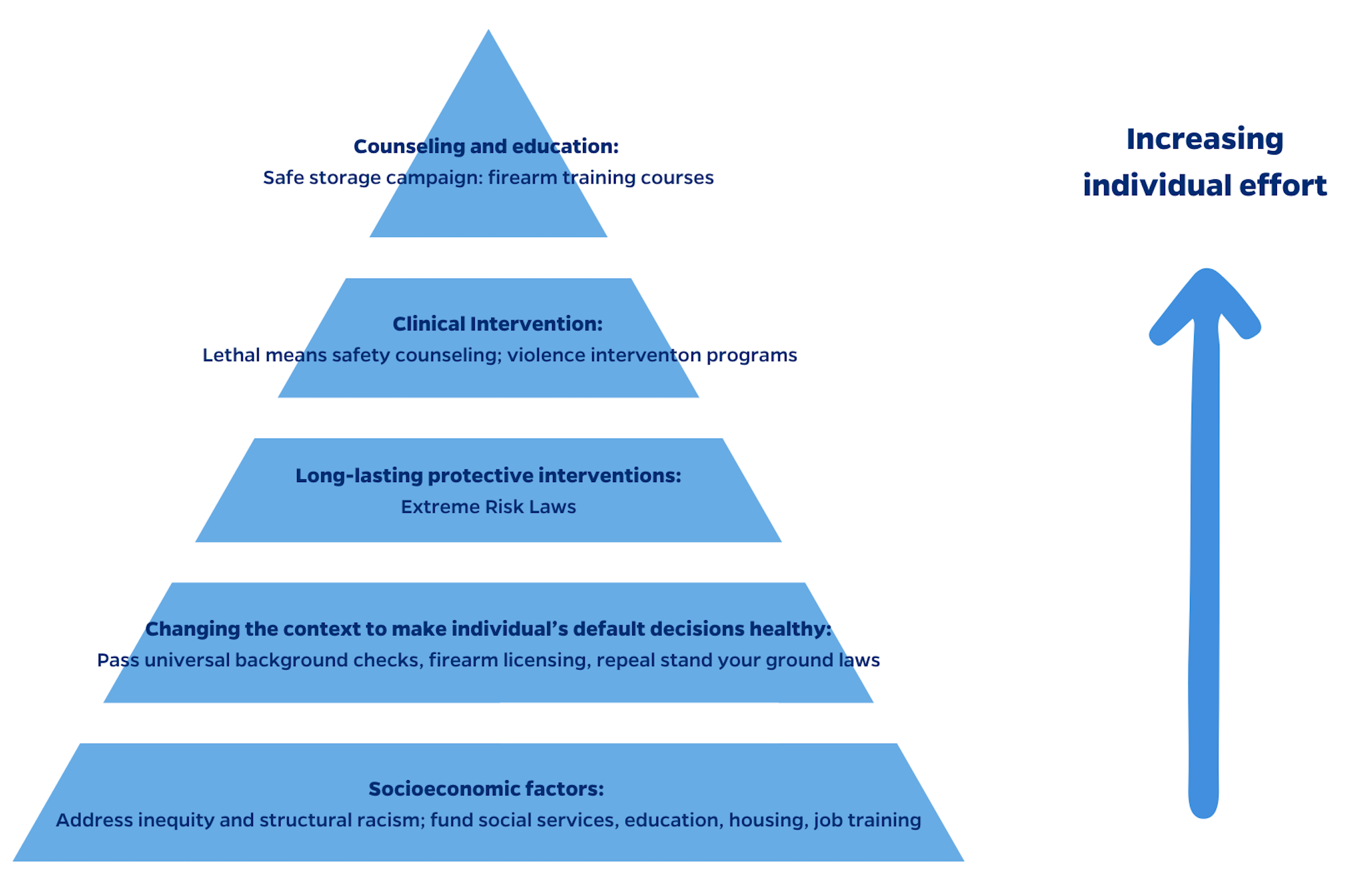
At the top of the public health pyramid are narrowly tailored interventions that work with individuals at risk for gun violence. These interventions, like lethal means safety counseling and violence intervention programs, can have tremendous impact in reducing gun violence. Yet, they also require individual action. These programs provide the tools and support to change behavior, but the individuals themselves must be willing to take action and change behavior.
The middle of the pyramid includes interventions that require less individual action. They are often laws and policies that change the environments within communities to mitigate risk factors. One such policy is universal background checks and firearm purchaser licensing. Research shows that when individuals are required to undergo a background check and obtain a license to purchase a firearm, far fewer firearms are diverted into illegal markets and used to perpetrate violence.
At the bottom of the pyramid are the conditions within society that lead to poor health outcomes like gun violence. These factors are often referred to as the root causes or social determinants of health. Socioeconomic factors, such as racial disparities, inequality, poverty, inadequate housing and education, are all risk factors for interpersonal gun violence. Policies that address these root causes have enormous potential to reduce gun violence and improve health. These policies, while requiring a broad collective effort to achieve, require minimal individual effort to be effective at reducing gun violence.
How Do We Address Gun Violence Through the Public Health Approach?
The public health approach is multifaceted and comprehensive and brings together institutions and experts across disciplines in a common effort to develop a variety of evidence-based interventions.5 This comprehensive approach to tackling public health crises in America has been used over the last century to eradicate diseases like polio, reduce smoking deaths, and make cars safer. This public health approach has saved millions of lives. We can learn from the public health successes—like car safety—and apply these lessons to preventing gun violence.
One of the greatest American public health successes is our nation’s work to make cars safer.
By using a comprehensive public health approach to car safety, the United States reduced per-mile driving deaths by nearly 80% from 1967 to 2017.6 This public health approach to car safety prevented more than 3.5 million deaths over these fifty years.7 In the years since 2017 car crashes have begun to increase. This recent increase illustrates how threats to public health constantly evolve, and the work of public health practitioners is never complete. They must continue to monitor the problem, identify emerging risks, and develop new solutions. While the work in U.S. auto safety is far from complete, the comparisons illustrates the steps needed to address the epidemic of gun violence. To reduce gun violence, we should apply this same time-tested public health approach.
Sources: National Traffic Highway Safety Administration (NTHSA). Motor Vehicle Traffic Fatalities and Fatality Rates, 1899-2017; Centers for Disease Control and Prevention, National Center for Health Statistics. National Vital Statistics System, Mortality 1968-2017 on CDC WONDER Online Database.
Applying the Public Health Successes of Auto Safety to Prevent Gun Violence
| Preventing Car Crashes | Preventing Gun Deaths | |
|---|---|---|
| Research | Allocate funds to study the epidemic of motor vehicle crashes. | Allocate funds to the CDC and the NIH to research gun violence. |
| Regulate | Federal agencies regulate car manufacturers and ensure car safety. | Allow federal agencies to regulate firearm manufacturers and ensure gun safety. |
| Licensing | Drivers must submit an application and pass a test to obtain a driver’s license. | Require firearm purchasers to submit an application, undergo a background check, and take safety education to obtain a license to own a firearm. |
| Registration | Car registration is required at each point of sale. | Pass firearm registration laws to ensure that firearms are registered at each point of sale. |
| Prohibit Risky People | Reckless and drunk driving laws ensure that risky individuals do not endanger others on the road. | Expand firearm prohibitions to include individuals who are at elevated risk for violence. |
| Manufacturing Standards | Manufacturers are required to make safer cars by installing seat belts and airbags. | Require manufacturers to make fireams safer, including requiring that guns be outfitted with microstamping technology. |
| Age Requirements | Age requirements for obtaining a driver’s license, including a graduated licensing system (driver’s permit) for young drivers. | Enact stronger age requirements for owning or possessing all types of firearms. |
| Licensing Renewal | Drivers are required to renew their license periodically. | Require gun owners to renew their license on a routine basis. |
| Ongoing Monitoring & Regulation | New models of cars are monitored and regulated, and recalls are issued for unsafe models. | Allow Consumer Product Safety Commission to regulate safety of firearms and ensure industry accountability. |
| Liability | Manufacturers are held liable if they sell a dangerous vehicle. | Repeal the Protection of Lawful Commerce in Arms Act (PLCAA) to hold firearm manufacturers accountable for dangerous and reckless distribution of firearms. |
Most Americans Support Our Priority Solutions.
82%
support removing guns during a DVPO.
72%
support firearm purchaser licensing laws.
77%
support family-initiated ERPO.
74%
support requiring someone to lock up their guns when not in use.
Recommendations
Apply the public health approach for effective gun violence prevention.
Public health is the science of reducing and preventing injury, disease, and death and promoting the health and well-being of populations through the use of data, research, and effective policies and practices. The public health approach has been successfully applied to tackle a wide variety of complex health problems at the population level. Gun violence is a public health epidemic that requires public health solutions.
Better Data Collection
Federal, state, and local governments should collect more comprehensive gun violence data for fatal and non-fatal firearm injuries, shootings that may not involve physical injuries, and firearm-involved crimes where no shots were fired, including domestic violence-related threats. Federal, state, and local governments should make data publicly available where possible and particularly to researchers studying gun violence and its prevention.
Research Funding
Enhanced research funding is key for advancing knowledge and improving public health interventions and outcomes. Federal, state, and local governments, in addition to foundations and universities, should dedicate funding to research gun violence prevention.
Evidence-based Policies & Practices
Gun violence is a mulitifaceted problem that takes many forms and requires a multitude of data-driven solutions. Gun violence prevention policies and practices should be evidence-based.
- Firearm Purchaser Licensing or permit-to-purchase laws require all prospective gun purchasers to obtain license prior to buying a gun from a dealer or a private seller. These laws enhance universal background checks by establishing a licensing application process as well as considering additional components such as fingerpinting, a more through vetting process, and a built-in waiting period to prevent individuals with a history of violence, those at risk for future interpersonal violence or suicide, and gun traffickers from obtaining firearms.
- Extreme Risk Protection Order (ERPO) is a civil process allowing law enforcement, family members, and, in some states, medical professionals and other parties to petition a court to temporarily restrict access to guns from individuals determined to be at elevated risk of harming themselves or others. ERPO laws are associated with lower rates of firearm suicide and have been successfully used in mass shooting threats.
- Community Violence Intervention (CVI) programs aim to identify and support the small number of people at risk for violence by providing them with wraparound mental health and social supports. Investing in CVI programs provides a public health approach to gun violence prevention, interrupting cycles of violence, and addressing the unique needs of the community where systemic racism, disinvestment, and trauma occur.
- Safe and secure gun storage practices, such as Child Access Prevention (CAP) laws, require households with a child or teen to keep firearms unloaded and locked when unattended. These practices promote responsible firearm storage practices protecting children and teenagers from various forms of gun violence, including unintentional shootings and gun suicides. CAP laws are linked to sizable reductions in child and teen gun deaths, including reductions in youth suicide, accidental shootings, and homicides.
- Public carry of firearms poses a serious threat to safety. Permissive public carry and “stand your ground” laws increase violence by allowing people with violent histories to carry their firearms in public, providing more opportunities for armed intimidation and shootings in response to hostile interactions, and increasing criminals’ access to guns. States should regulate the carrying of guns in public by prohibiting open carry of firearms particularly in sensitive places, passing strong concealed carry permitting laws, and repealing “stand your ground” laws.
Implementation and Evaluation
It is essential to pass evidence-based policies that address gun violence, but that is not enough. Gun violence takes many forms and impacts a variety of groups, requiring ongoing surveillance and evaluation to ensure effective implementation of policies and practices. Federal, state, and local governments should dedicate resources to ensure proper implementation, education and ongoing evaluation of gun violence prevention policies.
The Center Resources
References
- Kim, R., Wagner, E. D., Nestadt, P. S., Somayaji, N., Horwitz, J., & Crifasi, C. K. (2025). Gun Violence in the United States 2023: Examining the Gun Suicide Epidemic. Johns Hopkins Center for Gun Violence Solutions, Johns Hopkins Center for Suicide Prevention. Johns Hopkins Bloomberg School of Public Health.
- Centers for Disease Control and Prevention. The National Center for Injury Prevention and Control, Division of Violence Prevention. The Public Health Approach to Violence Prevention.
- World Health Organization. Violence Prevention Alliance. The Public Health Approach.
- Frieden TR. (2010). A framework for public health action: the health impact pyramid. American journal of public health.
- Hemenway D, & Miller M. (2013). Public health approach to the prevention of gun violence. New England Journal of Medicine.
- Traffic Safety Facts: A Compilation of Motor Vehicle Crash Data. (2020). Annual Report Tables. National Highway Traffic Safety Administration.
- On 50th anniversary of ralph nader’s ‘unsafe at any speed,’ safety group reports auto safety regulation has saved 3.5 million lives. (2015). The Nation.
